
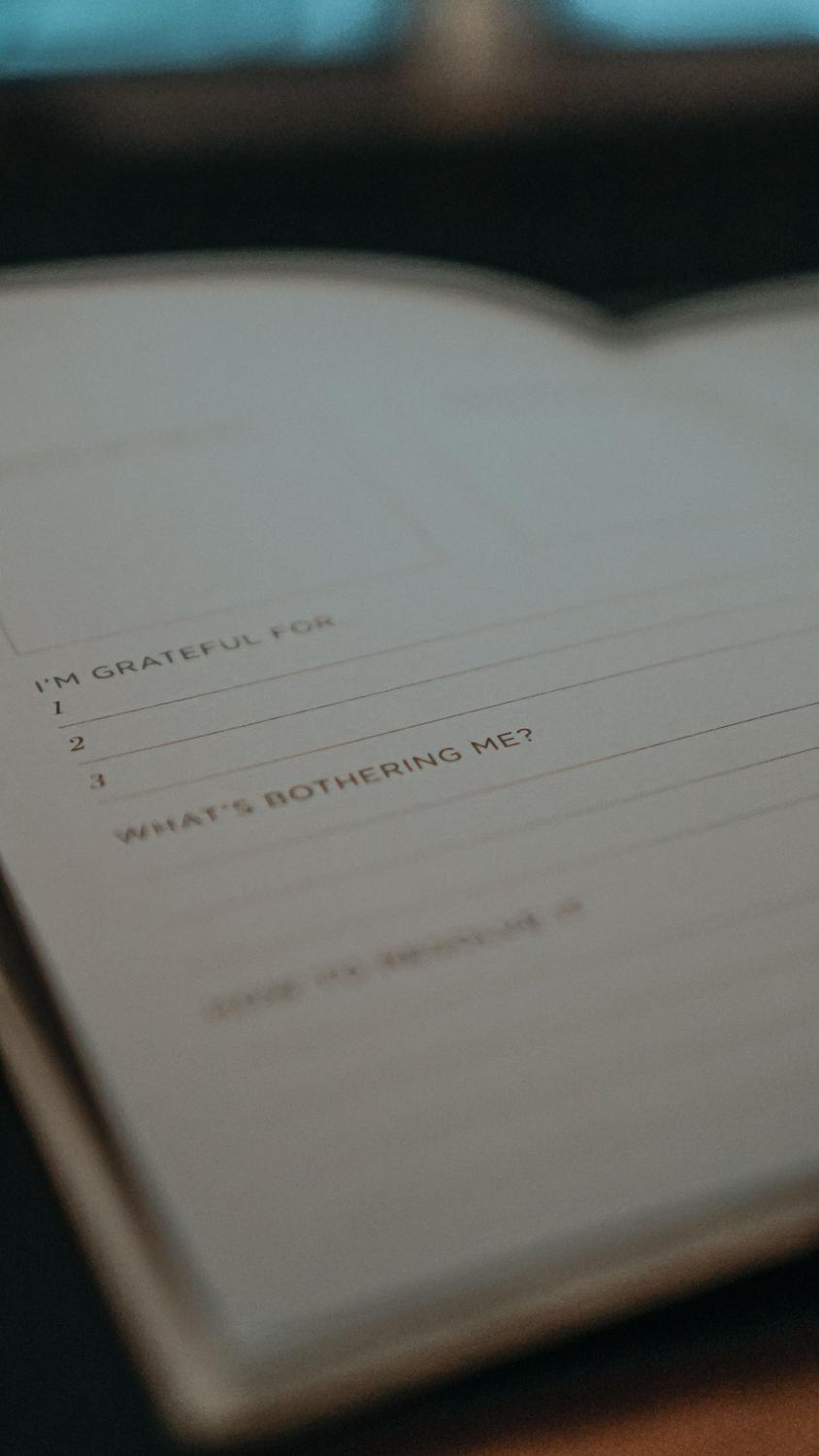
In my hardest years, I couldn't even name what was wrong. Everything just felt heavy. People told me to write it down, and I tried. I bought a beautiful blank notebook, sat down with a pen, and stared at the empty page until I closed it again.
A blank page asks you to know what you want to say. I didn't. That was the whole problem.
1. Questions Instead of a Blank Page
A guided journal is different. It asks you simple questions, the same few every day. What are you grateful for today? What is bothering you? What would make tomorrow a little better? You don't have to know where to start. You just answer.
Some evenings I could only fill one line. Some evenings the "grateful" lines were very small things: warm tea, a quiet car ride, the dog's head on my knee. That counts too. Those small lines became a story of their own (I wrote about it in Something to Be Grateful For).
2. The Day Finally Has Somewhere to Go
What surprised me most was the second question. Writing down what was bothering me, in a few honest words, made it smaller. It was on the page, not only in my head. Five minutes before bed, and the day finally had somewhere to go.
I don't write every evening. I am not that disciplined, and I have learned not to punish myself for it. But when I come back to it, the questions are still there, waiting, never judging the empty days.
The Evening Edit
A guided journal with simple daily prompts for gratitude, reflection and what is on your mind, a few minutes each evening.
Shop the Edit3. Honest Notes
A journal helps you notice and organize your thoughts, but it is not a replacement for support from people or professionals when things are really hard. Dated journals can feel discouraging when you miss days, so an undated one is often kinder. And if you love writing freely, the prompts may feel limiting; some journals mix guided and blank pages.
4. How to Choose
- Undated pages let you start any day and skip days without guilt.
- Short prompts are easier to keep up than long, deep questions every night.
- A lay-flat binding is much more comfortable to write in.
- Choose a size that fits on your nightstand, so it stays where you will see it.
5. Questions People Ask
How long should I write each day? Five minutes is enough. The habit matters more than the length, and a few honest lines count.
What if I don't feel grateful? Write small. A warm drink, a moment of quiet, the end of the day itself. Gratitude doesn't have to be big to be real.
You don't have to have the answers. Sometimes it is enough to have better questions.